
Checking Criminal History in Naples
Start by deciding which record answers the question. A Naples police report describes the local event. A CCSO booking entry shows jail intake and the charges asserted then. Collier Clerk Showcase shows charges actually filed, hearings, pleas, disposition, and sentence. FDLE compiles fingerprint-supported Florida arrest events and reported outcomes. None is a substitute for all the others.
- Confirm that the event occurred inside Naples city limits and identify Naples Police as the responding agency.
- Ask NPD Records for the report by case number, or give the place, date, approximate time, and party names.
- Use the county arrest channel for a related booking.
- Search Collier Clerk Showcase for the filed case and disposition.
- Use FDLE's Florida Criminal History Search when a statewide public history is needed.
For deeper county arrest detail, the Collier County arrest lookup explains the booking channel and its limits.
Naples Addresses and Police Jurisdiction
A postal address that says Naples does not prove that Naples Police made the report. The incorporated city covers 12.30 land square miles, while many Naples mailing addresses lie in unincorporated Collier County. Those areas are served by CCSO. Check the report number, badge or agency name before sending a request. A misrouted request costs time and may produce a valid response that simply says the city has no responsive file.
If the event was outside city limits, direct incident and arrest-report questions to CCSO Central Records at 3319 Tamiami Trail E., Naples. The county route does not turn the record into an NPD record merely because the address uses Naples.
Naples Police Department Records
NPD Records Services operates at 355 Riverside Circle, Naples, FL 34102. The counter is open weekdays from 8 a.m. to 5 p.m. Requests may be made in person, by phone at (239) 213-4890, by fax at (239) 213-4899, by mail, by email to PolicePRR@naplesgov.com, or through the city's online public-record workflow. Staff search and reproduce police material and handle the department's UCR reporting.
The official Naples Police records page shows the unit that receives these requests.
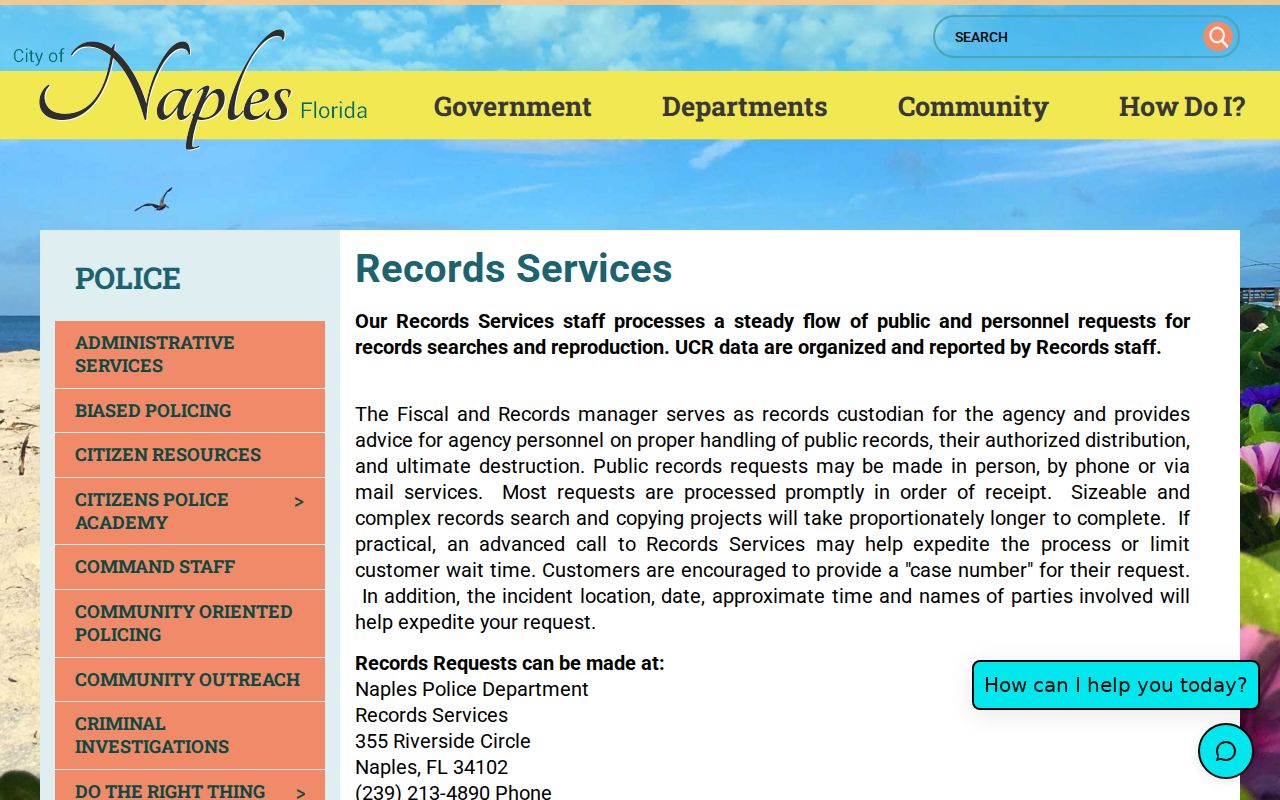
This source helps a requester verify the current counter details before choosing an online or offline channel.
Inside Naples Police Administration
Administrative Services provides the local context for record intake and release. The official police material is useful when the question concerns an NPD event, but it does not contain the county jail file or the clerk's judicial docket.
The city's Administrative Services page identifies that police function.
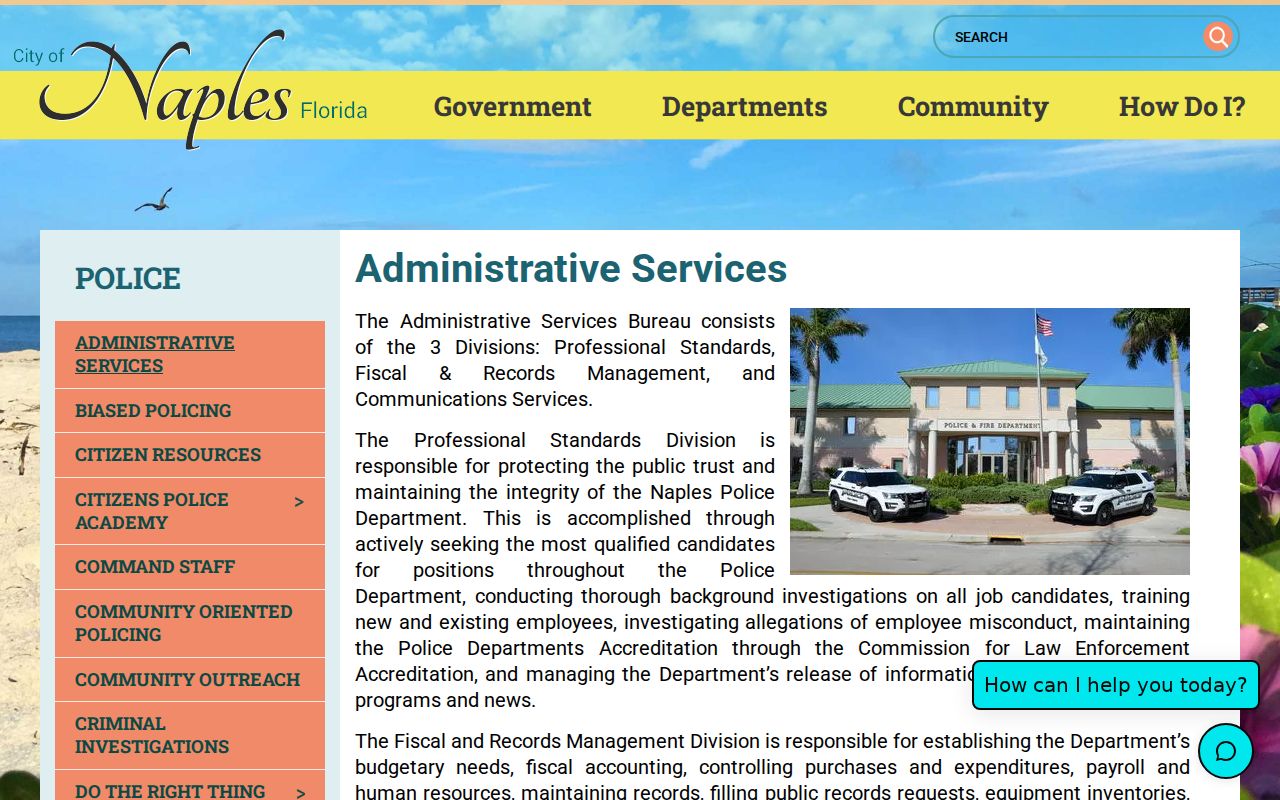
Keeping the custodians separate prevents a police report from being mistaken for proof of a conviction.
Naples Report Release Limits
NPD lists adult arrest reports, juvenile felony arrest reports, and offense or incident reports from closed investigations among releasable materials. That does not mean every page is open. Active-investigation information, protected victim details, juvenile material, and personal identifiers may be withheld or redacted under Florida law.
Crash records have their own timing rule. They remain confidential for the first 60 days except for authorized involved persons. Traffic-homicide records remain confidential for 60 days after the investigation ends, again subject to authorized access. The statewide Florida crash report channel is the proper source for its own products.
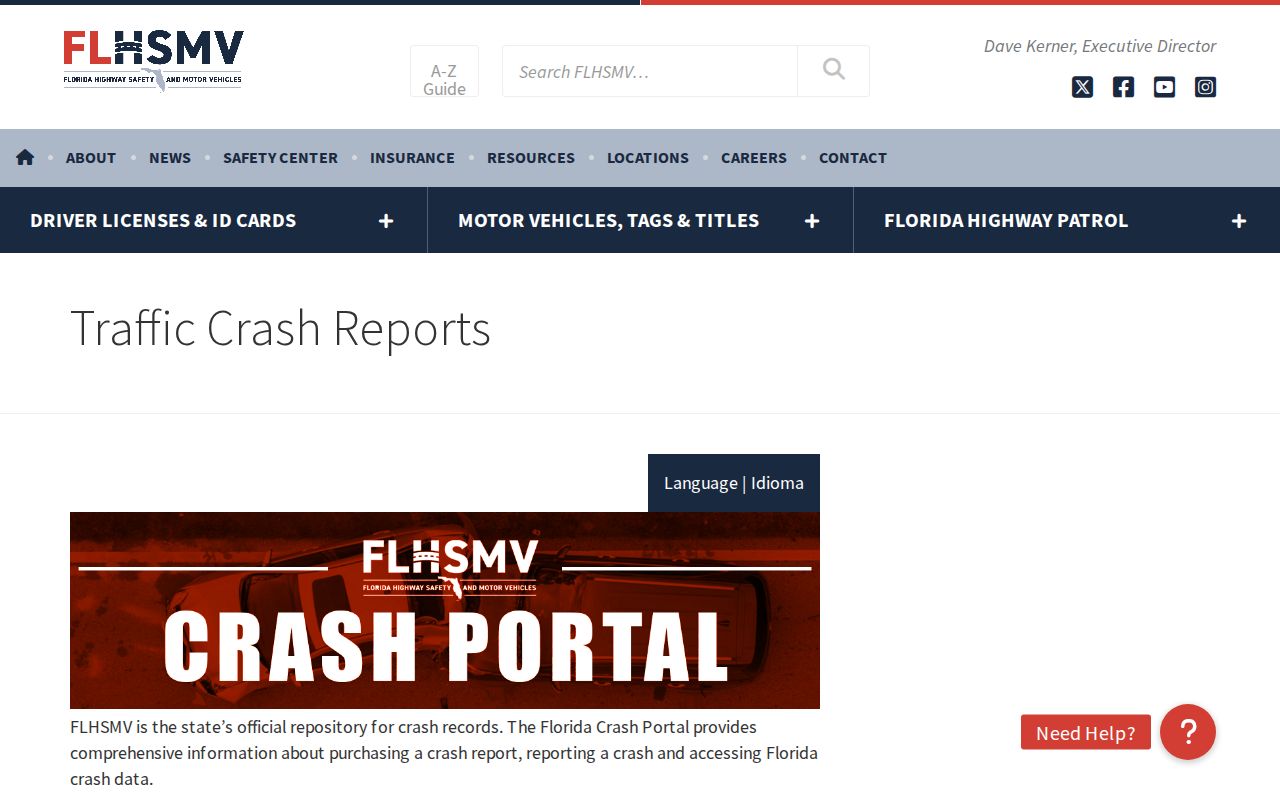
The crash system illustrates why the type and age of a Naples record affect who can receive it.
Naples Arrests and Bookings
NPD makes the arrest report, but Naples has no city jail. A person arrested by city officers enters the Collier County Sheriff's Office booking system. The booking entry can show intake data, asserted charges, custody status, and bond information. It is not a finding of guilt, and its charge wording may differ from the prosecutor's later filing.
Recent custody questions therefore go to CCSO rather than Riverside Circle. Older outcome questions go to the clerk. That split is central to a sound Naples criminal records search.
Naples Request Fees and Delivery
Naples lists copies at $0.15 per single-sided page and $0.20 per double-sided page. Up to 30 pages may be mailed without a copy charge when the requester supplies a stamped, self-addressed envelope. Certification costs $1. A special request may be billed at $21.55 per hour plus copies, and extensive work may produce an actual-cost special service charge.
Ask for an estimate when a request spans many dates, videos, or file types. Narrow terms help staff find the right record and reduce review work.
| Best identifier | Police case number |
|---|---|
| Useful fallback | Location, date, approximate time, and names |
| Delivery | Portal, email, mail, inspection, or in-person pickup |
| Status tools | Submit, track, and pay an invoice through the portal |
Naples Record Types Compared
A request for “the whole record” can cross three custodians. An incident report tells what an officer documented at the scene. An arrest report adds the legal basis and arrest details available to NPD. A jail record begins when CCSO accepts the person for booking. The later court file records what the State Attorney chose to prosecute, not merely what appeared at intake.
- Incident report
- The Naples Police account of a reported event, subject to investigative and privacy exemptions.
- Booking record
- The CCSO intake record, with custody facts and allegations at that point in time.
- Court docket
- The clerk's dated log of filed charges, hearings, documents, pleas, and result.
- FDLE history
- A Florida compilation of fingerprint-supported arrest cycles and reported dispositions.
Order each item by name when more than one is needed. That makes the request easier to price and prevents an incident report from being treated as a final case result.
Naples Municipal Court Records
Naples has no municipal criminal court. City ordinance and criminal matters route into Collier County Court or Circuit Court, depending on the charge. County Court handles misdemeanors and criminal traffic matters. Circuit Court handles felonies. Clerk Showcase is the city court-search channel in practice.
| Court Name | Collier County Court and Circuit Court |
|---|---|
| Case Types | Misdemeanor, criminal traffic, felony, and related city matters |
| Lookup | Collier Clerk Showcase, clerk counter, or court-record request |
| Docket | Case number, charges, events, pleas, disposition, sentence, and costs |
| Copies | Request from Collier Clerk when the public portal is not enough |
Naples Portal Requests and Public Email
The Naples portal routes a request by department and category. Select Police for NPD material. The description should include the case number or enough event detail to locate the file. Contact data is not required merely to make a Florida public-record request, but it may help with delivery, cost estimates, and status notices.
The city's public-record guidance warns that email addresses can themselves become public records.
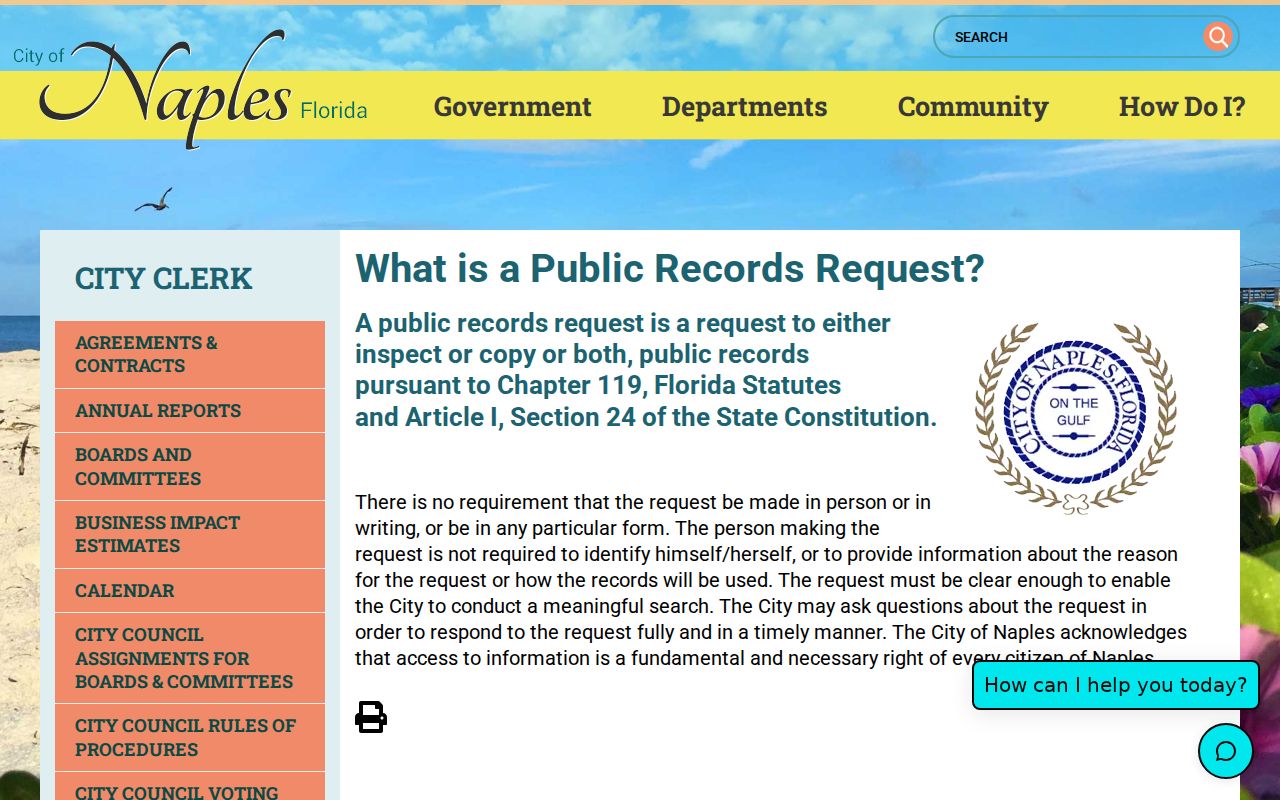
Phone, mail, and in-person options remain useful when a requester does not wish to use email.
Where Naples Criminal Records Go
A single event produces separate records at different times. NPD creates the incident and arrest report. CCSO creates the jail booking. The State Attorney decides which charge to file, and Collier Clerk preserves the resulting case. Criminal-justice agencies then report fingerprint events and dispositions to FDLE.
Record flow: Naples Police Department › CCSO booking › Collier County Courts › Florida Department of Law Enforcement.
Use the newest custodian for the newest fact. Police may have an incident before a booking appears. The court may open after prosecution begins. FDLE may receive the final result later.
Correcting a Naples Record
First compare the records before asking for a correction. A difference is not always an error. Police arrest language may change when the prosecutor files an information, and a court may dismiss or amend a count later. If NPD's own report contains a factual problem, contact its records unit and identify the case and disputed field. If the docket is wrong, contact Collier Clerk. An FDLE identity or disposition problem follows FDLE's free fingerprint-based Personal Review and challenge process under section 943.056.
Keep the source document that supports the requested change. A certified disposition can show how a filed case ended, while an arrest report alone cannot establish that final outcome.
Naples Criminal Record Search Gaps
A blank result may reflect jurisdiction, timing, or access limits. Confirm that the city rather than CCSO handled the event. Search the clerk with name variants and a date range, then ask the clerk about older public material that is not online. A sealed, expunged, juvenile, or confidential matter may lawfully stay out of public view. Active police material can also be withheld while an investigation remains open.
FDLE and Collier files can differ because they serve different scopes. FDLE depends on identifiers and disposition reporting from criminal-justice agencies. Clerk Showcase is the direct Collier case log. If a Florida history lacks a known outcome, obtain the certified Collier disposition and use FDLE's personal-review challenge route. That process is for the subject's own record and requires fingerprints taken by a law-enforcement or criminal-justice agency.
Do not fill a gap with a private people-search result. Return to the originating office and document the name, date of birth, case number, and agency used for each official search.
Public Access Rules in Naples
Florida Public Records Law applies to municipal police records unless a statute creates an exemption. Judicial files are chiefly governed by Florida Rule of General Practice and Judicial Administration 2.420. A custodian should provide nonexempt portions, redact protected content, and identify the legal basis for a denial.
Key Statutes:
Florida Statute §119.01 establishes the state's public-record policy.
Florida Statute §119.07 governs inspection, copies, redaction, and stated denial grounds.
Florida Rule 2.420 protects confidential court information while preserving access to public portions.
Access does not prove guilt. Compare the arrest allegation with the filed charge and final disposition before drawing a conclusion.