
Checking Criminal History in Marco Island
Choose the channel by record type. MIPD holds its police reports. CCSO holds the booking made after a city arrest. Collier Clerk holds filed charges and the case outcome. FDLE holds a statewide compilation based on fingerprint-supported events and reported dispositions. Searching only one can miss a later change or an earlier local report.
- Ask Marco Island Police whether it handled the incident.
- Request the MIPD report with a report number, date, place, and record type.
- Check the official CCSO booking source for custody information.
- Search Collier Clerk Showcase for the prosecution and disposition.
- Use FDLE's Florida Criminal History Search for a statewide public name check.
The Collier County criminal court cases resource explains fields found after a prosecutor files charges.
Marco Island Police Records
The Marco Island Police Department is at 51 Bald Eagle Drive, Marco Island, FL 34145. Its nonemergency number is (239) 389-5050. Police and code records requests belong with the MIPD Records Unit rather than a general city inbox. The documented channels include email to publicrecords@cityofmarcoisland.com, mail, and an in-person request.
The official Marco Island Police page provides the department's current public-facing information.
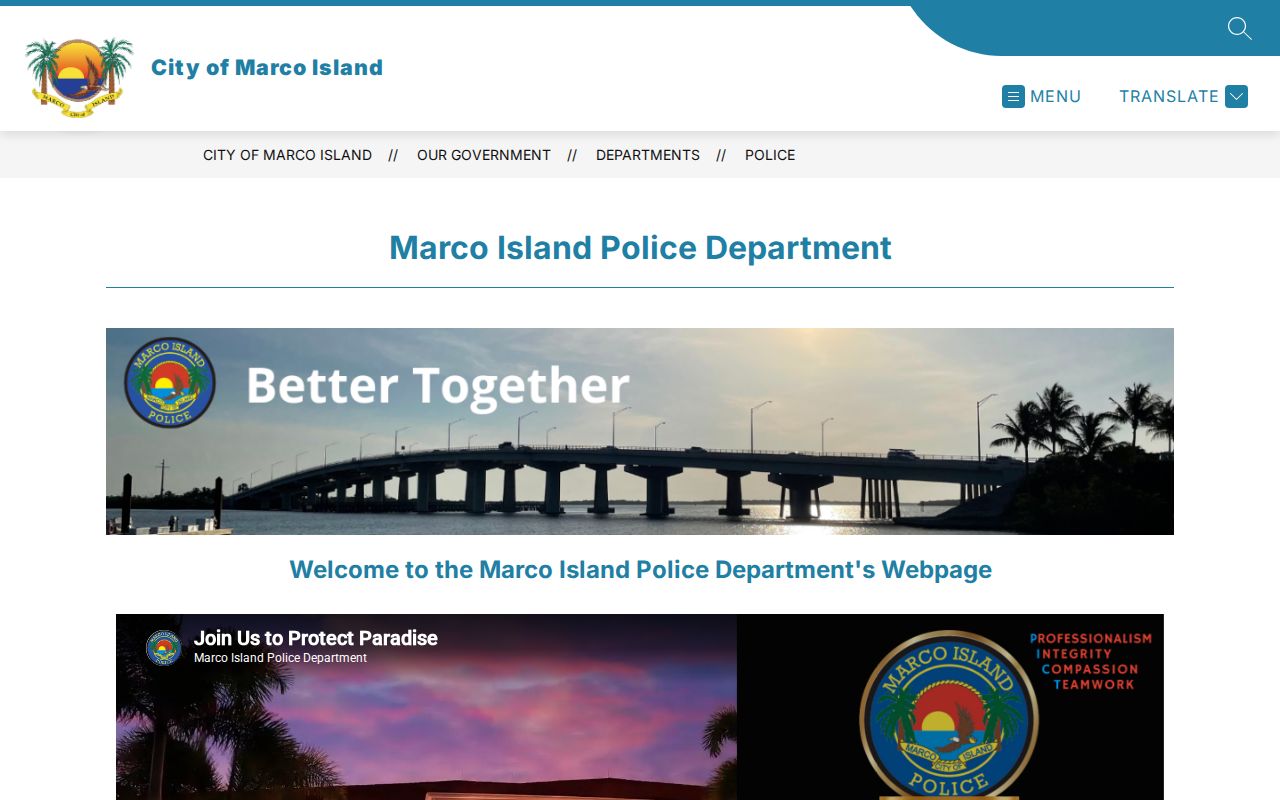
This city source is the right starting point for a report created by MIPD, not for a jail or court record created later.
Route Marco Police Requests Correctly
A broad message to the city can delay a police-record search. Identify the person or department as MIPD Records, and describe the record with enough detail to locate it. A report number is best. Without one, give the event date, location, subject, and requested file type. Contact details are legally optional for a Florida public-record request, though they help the city send an estimate or deliver the result.
| Routing field | Person or department, directed to MIPD Records |
|---|---|
| Description | Report number, date, place, subject, and record type |
| Delivery | Email, mail, or inspection |
| Signature/date | Form fields; the special form is not legally mandatory |
A precise request also makes it easier to separate police files from code-enforcement or general city records.
Marco Island Monthly Police Reports
MIPD publishes monthly reports as official local context. The research inventory confirmed reports for December 2024 and January 2025. A reader should name the exact month and year used, since an agency summary is not a live person-search system and does not establish what happened in another month.
Monthly totals can describe reported activity and department work. They cannot replace a named report, booking entry, or court disposition. They also deserve more weight than a private crime score because the city is the source and explains the reporting period.
Marco Island Safety Claims in Context
The department's “safest city” language is agency messaging, not a standard statistic that answers a criminal-record question. Crime measures depend on the data set, year, population estimate, offenses counted, and whether the number reflects reports or convictions. Use the city's monthly material for the period it covers and label it that way.
For a person or event, request the underlying MIPD file. For a prosecution, use the clerk docket. Neither a slogan nor a broad rate can confirm an individual's arrest or court result.
Marco Island Arrests and Bookings
Marco Island has no city jail. When MIPD officers make an arrest, custody and booking move to the Collier County Sheriff's Office. The booking entry reflects intake, the arresting agency, custody status, bond, and charges alleged at that stage. It is not a conviction and can differ from the charge later selected by the State Attorney.
MIPD remains the source for the police report. CCSO becomes the source for jail intake. Collier Clerk becomes the source for the judicial case. The Collier arrest lookup gives the county-level booking and records-request routes.
Victim Identity Redaction Requests
Marco Island maintains a dedicated victim-identity redaction channel. It is distinct from asking for an incident report. A person seeking protection of qualifying information should use the city process and describe the record in which the identity appears. The custodian determines whether a Florida exemption applies and may redact protected parts while releasing the rest.
Do not assume an entire report becomes secret because one field is protected. Florida's access framework calls for nonexempt portions to remain available when they can reasonably be separated.
Marco Island Prosecutor Records
A police arrest does not automatically become the same court charge. The State Attorney for Florida's Twentieth Judicial Circuit reviews the police submission and decides what, if anything, to file. The Collier office is at 3315 E. Tamiami Trail, Suite 602, Naples, FL 34112, and its published telephone number is (239) 252-8470. The office includes Victim/Witness Services as well as units for domestic violence, economic crimes, special victims, and cold cases.
The official State Attorney offices page supplies the circuit office context relevant to Marco Island cases.

The prosecutor's file and the clerk docket begin after the MIPD investigation, which is why arrest wording may not match the filed information.
Marco Island Municipal Court Records
There is no Marco Island municipal criminal court. Criminal and ordinance matters proceed through Collier County Court or Circuit Court. County Court hears misdemeanor and criminal traffic matters. Circuit Court hears felonies. Clerk Showcase is therefore the honest city case-search channel, even though it is county operated.
| Court Name | Collier County Court and Circuit Court |
|---|---|
| Case Types | Misdemeanor, criminal traffic, felony, and related city matters |
| Lookup Channel | Clerk Showcase, courthouse terminal, or clerk records request |
| Docket Contents | Filed charges, dates, events, pleas, disposition, sentence, and costs |
| Unavailable Files | Ask Collier Clerk for older or non-online public material |
Three Marco Island Record Custodians
The police report, booking, and court case answer different questions. An MIPD report records the officer's investigation and arrest facts. A CCSO booking records jail intake and initial charges. The court file shows the prosecutor's filed counts and the judge's final result. FDLE may later connect the arrest cycle to a reported disposition.
- Report
- Best for the event and officer narrative, subject to exemptions.
- Booking
- Best for local custody and intake status.
- Docket
- Best for filed charges, hearings, pleas, and outcome.
- State history
- Best for a broader Florida fingerprint-based compilation.
Compare names, dates, case numbers, and charge changes rather than forcing the files to match word for word.
Pre-1998 Marco Island Records
Marco Island incorporated in 1997. The city's permitting guidance notes that records from before 1998 may remain with Collier County because the municipality did not yet exist as today's custodian. The point extends to record routing: age and originating agency matter more than a modern street address.
Ask the city first when the file is clearly an MIPD record. For older activity, identify which county agency performed the function at the time. A county-held historical file does not become a city file after incorporation.
Missing Marco Island Criminal Records
No-result searches need a methodical check. Verify spelling, aliases, the event date, and whether MIPD or another agency responded. A new arrest can appear in a booking source before the prosecutor files a case. A disposition can appear at Collier Clerk before FDLE connects it to the statewide arrest cycle. Older records may require a direct request instead of an online query.
Legal restrictions also matter. Sealed and expunged records are not public. Juvenile files, protected victim information, active criminal intelligence, and account or identity data may be confidential. A custodian can redact exempt content while releasing the remainder. Ask for a written citation when access is denied rather than assuming that a blank portal proves no record exists.
For an apparent error in a Florida statewide history, the subject may use FDLE's free fingerprint-based Personal Review under section 943.056. A clerk-certified disposition is useful when the problem concerns a missing or incorrect case outcome.
Where Marco Island Records Go
An MIPD event moves through several systems if it leads to arrest and prosecution. City police create the report. CCSO books the arrested person. The State Attorney decides what to file. Collier Clerk records the case. Agencies report qualifying fingerprint events and dispositions to FDLE.
Record flow: Marco Island Police Department › CCSO booking › Collier County Courts › Florida Department of Law Enforcement.
Timing explains many gaps. A new police report may exist before a court number. A final disposition may appear at the clerk before FDLE receives it. Check the source nearest the event when speed matters.
Marco Island Record Terms
Court language can show why a booking charge and final result look different. An information is the State Attorney's formal charging document. The docket is the dated case log. A nolle prosequi means the prosecutor stopped a filed charge. A withhold means the court did not enter a formal adjudication of guilt despite a plea or finding, and it is not the same as a dismissal.
Disposition means the operative result for a count. Read it beside the charge and adjudication fields. A case may contain more than one count, and each can end differently. Bond describes release and appearance conditions, not punishment or a finding of guilt. These distinctions make the clerk file essential when a Marco Island police or booking record lists only the earlier allegation.
Public Access Rules in Marco Island
Chapter 119 governs access to city police records, subject to exemptions for matters such as active criminal intelligence, protected victims, juveniles, and personal identifiers. Court access follows Rule 2.420. Ask for segregable public portions and a specific legal basis when material is withheld.
Key Statutes:
Florida Statute §119.01 states Florida's public-record policy.
Florida Statute §119.07 addresses inspection, copies, redaction, and denial grounds.
Florida Rule 2.420 governs public and confidential judicial records.
A public file is not proof that every allegation was sustained. Read the disposition and sentence fields before relying on an arrest charge.