
Checking Criminal History in Everglades City
The first question is whether the requested item is a city administrative record or a law-enforcement record. City Clerk handles council, ordinance, and other municipal files. CCSO handles police incidents, arrests, and jail bookings. Collier Clerk handles the criminal case. FDLE supplies a separate statewide history based on fingerprint-supported events and reported outcomes.
- Send city-government requests to the Everglades City Clerk.
- Ask CCSO Central Records for incidents and arrest reports inside the city.
- Use CCSO's official channels for booking and custody information.
- Search Collier Clerk Showcase for filed charges and disposition.
- Use FDLE's Florida Criminal History Search for broader Florida results.
The wider Collier County criminal history overview explains how those systems differ.
No Everglades City Police Department
The official city directory lists no municipal police department. CCSO is the law-enforcement custodian for incidents within Everglades City. Do not send an arrest-report request to City Hall merely because the event happened inside the municipality. The City Clerk can answer for municipal records but cannot produce a sheriff's report or jail entry.
For a CCSO report, identify the incident number when known. Otherwise provide the exact city location, date, approximate time, involved names, and requested file type. Central Records is at 3319 Tamiami Trail E., Naples, with telephone service at (239) 252-0637 and online, mail, and email channels.
Everglades City Hall Records
City Hall is at 102 Copeland Ave. N., Everglades City, FL 34139. Its main number is (239) 695-3781, fax is (239) 695-3020, and regular hours are weekdays from 9 a.m. to 4:30 p.m. Mail may be addressed to P.O. Box 110. Those details serve city business records, not CCSO police files.
The official Everglades City site identifies City Hall and its public contact.
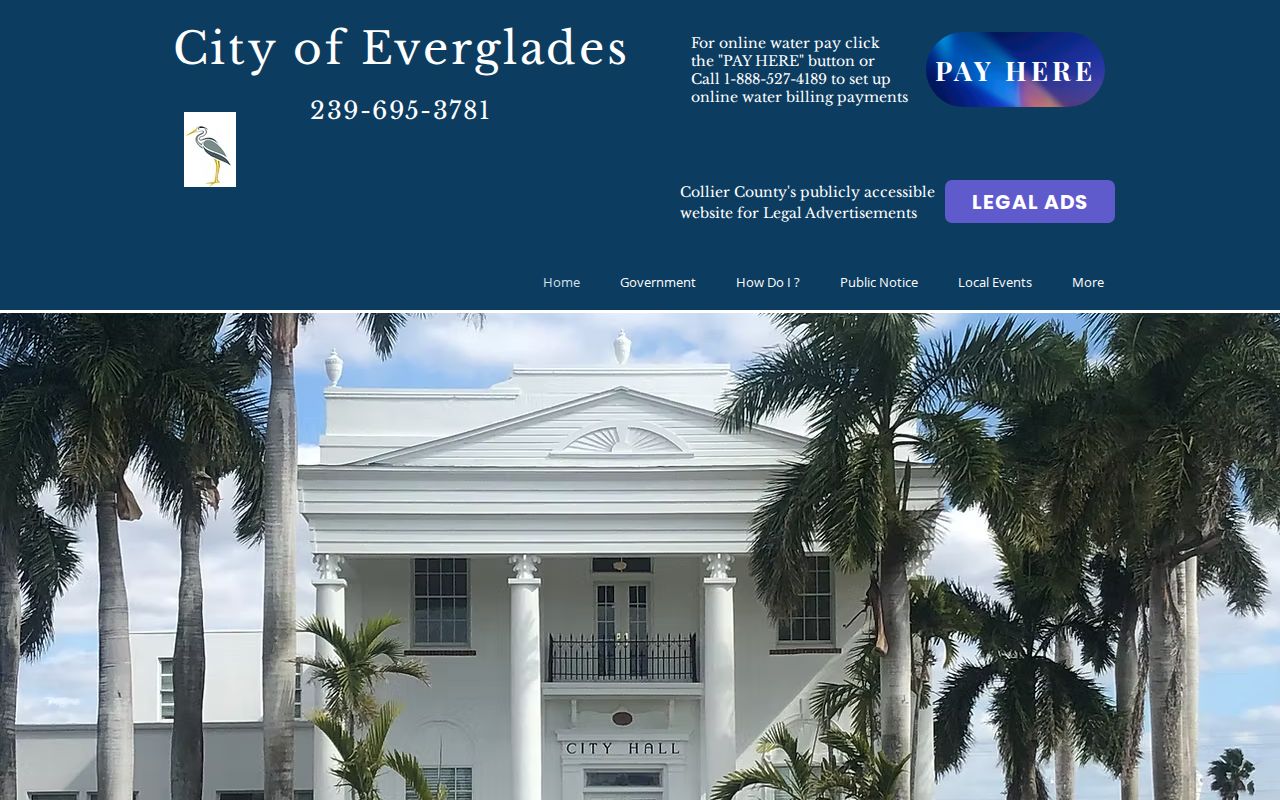
The city source helps visitors confirm office access before traveling from another part of Collier County.
Copeland Avenue Clerk or CCSO
The City Clerk is the custodian for Everglades City documents. Police records belong to CCSO. That line matters because both may mention the same place or person for different reasons. A council agenda, code file, or city resolution is administrative. An incident narrative, arrest affidavit, booking entry, or criminal charge is part of the county justice chain.
| Requested item | Start with |
|---|---|
| Council agenda or resolution | Everglades City Clerk |
| Code-enforcement file | Everglades City Clerk |
| Incident or arrest report | CCSO Central Records |
| Jail booking | CCSO corrections channel |
| Filed criminal case | Collier Clerk |
Using the right noun in the request is often as important as using the right office.
Everglades City Clerk Request Channels
The clerk and records custodian may be reached at (239) 695-4558 or DSmallwood@CityofEverglades.org, by mail, or at City Hall. A request can be oral or written. Describe the subject, date range, and type of city file. Contact information is not documented as mandatory, although it helps a small office clarify scope and arrange delivery.
The city's official “How Do I” page provides that records route.
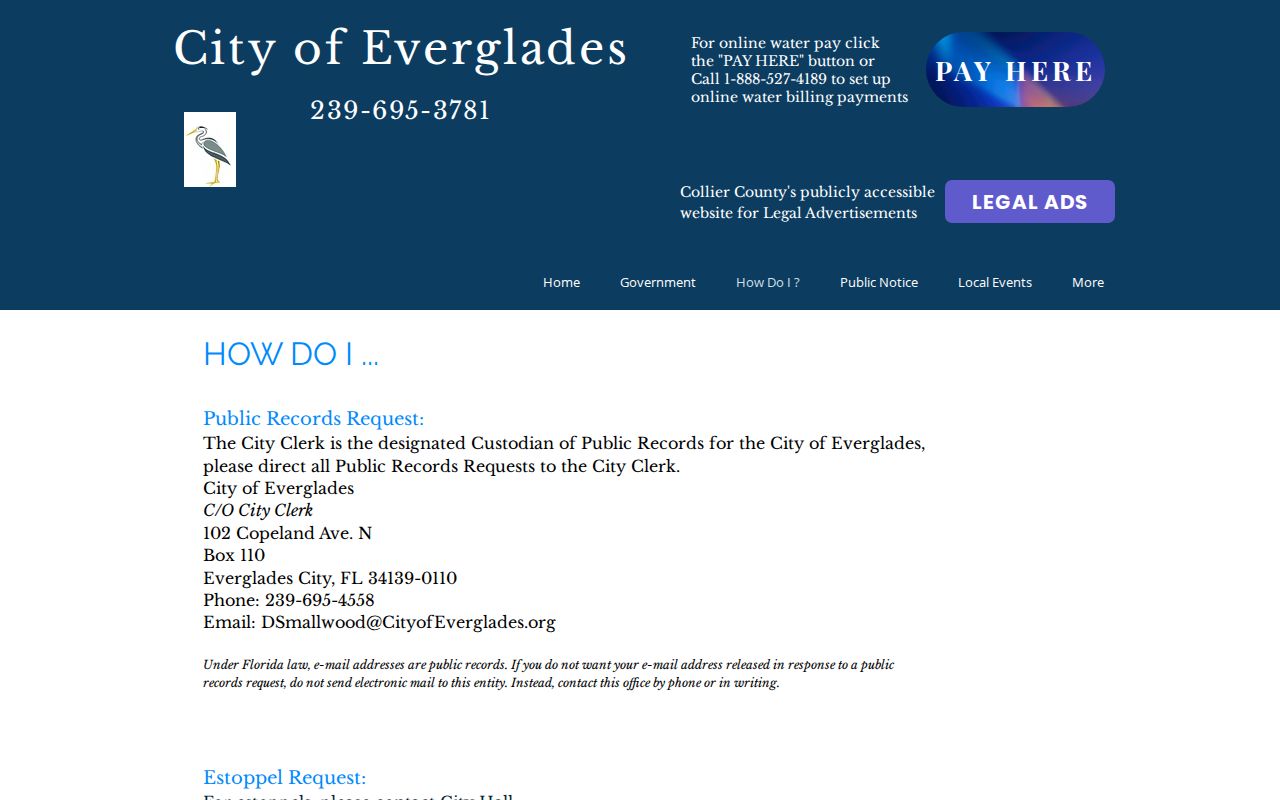
Email addresses become public records, so phone, writing, mail, and in-person channels provide useful alternatives.
Everglades City Arrests and Bookings
CCSO creates the report for a local police incident and the booking record when an arrest leads to jail intake. Those are two records, not one. The report focuses on the event and investigation. Booking focuses on custody, intake, bond, and charges alleged at that time. A booking does not prove guilt.
The State Attorney later chooses what charge, if any, to file. Collier Clerk then opens the judicial case. For current or recent custody, use CCSO. For the legal outcome, use the Collier criminal court case search.
Everglades City Municipal Court Records
Everglades City has no municipal criminal court. Criminal cases proceed through Collier County Court or Circuit Court in Naples. County Court hears misdemeanors and criminal traffic matters, while Circuit Court hears felonies. The county clerk portal and records office are therefore the local case route.
| Court Name | Collier County Court and Circuit Court |
|---|---|
| Case Types | Misdemeanor, criminal traffic, felony, and related matters |
| Lookup | Clerk Showcase, courthouse terminal, or court-record request |
| Docket | Filed charges, dates, pleas, disposition, sentence, and costs |
| Copies | Request from Collier Clerk when a public online view is incomplete |
A city code hearing is not a substitute for this criminal docket.
Code Hearings Are Not Criminal Cases
Everglades City Council meets on the first Tuesday at 7 p.m., while code-enforcement hearings are scheduled for third Tuesdays. Code enforcement is an administrative local process. Its agenda or order may be a public city record, but it is not a criminal court conviction and should not be described as one.
The city meetings and agendas page shows those local proceedings.
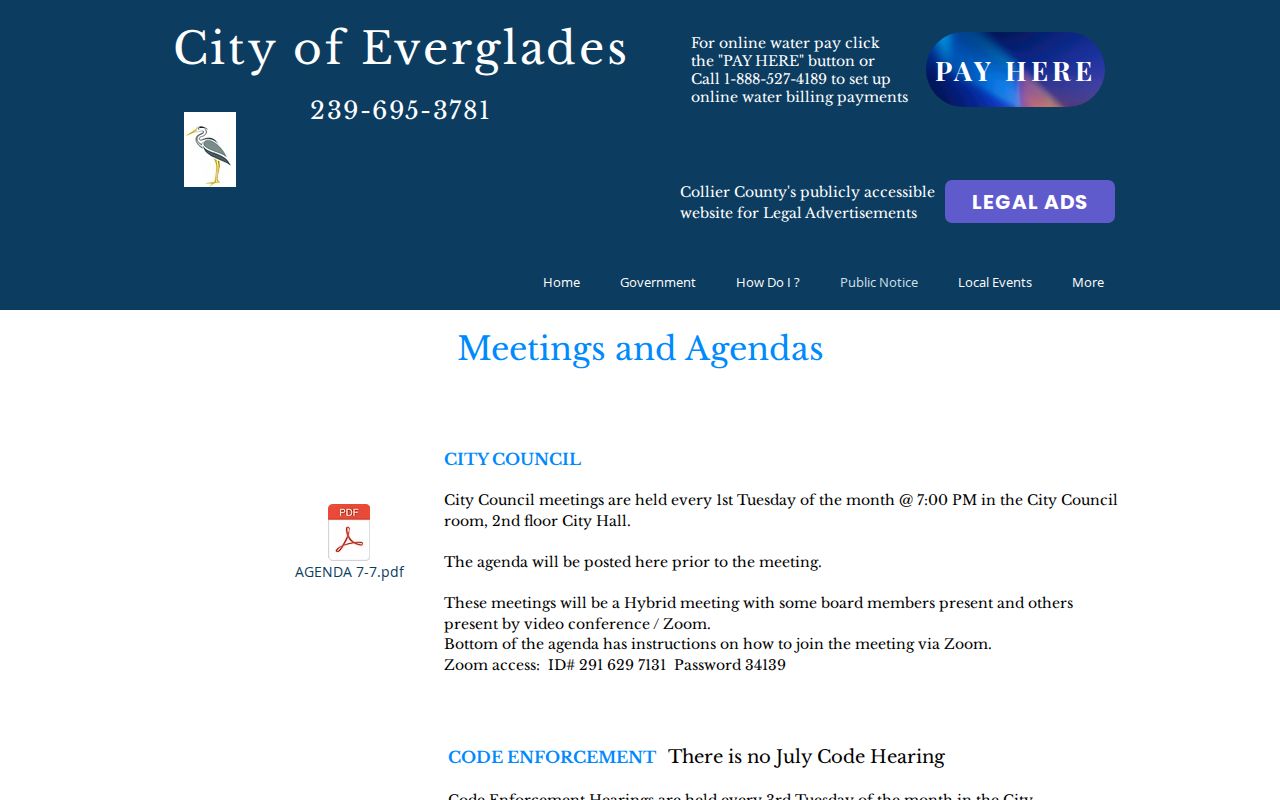
Checking the proceeding type prevents an ordinance or property matter from being confused with a county prosecution.
Everglades City History and Record Custody
Everglades City once served as the Collier County seat. Its official history traces Calusa and Glades occupation, an 1892 trading post, an 1895 post office, Barron Collier's 1922 acquisition, and the 1923 creation of the county and city. Rail and the Tamiami Trail then tied the small community to the region.
Hurricane Donna caused major destruction in 1960. The county seat moved to Naples in 1962, and the statutory name Everglades City arrived in 1965. That history explains why today's criminal courts and primary county record custodians are in Naples, even for an event within Everglades City.
The city's official history documents that shift.
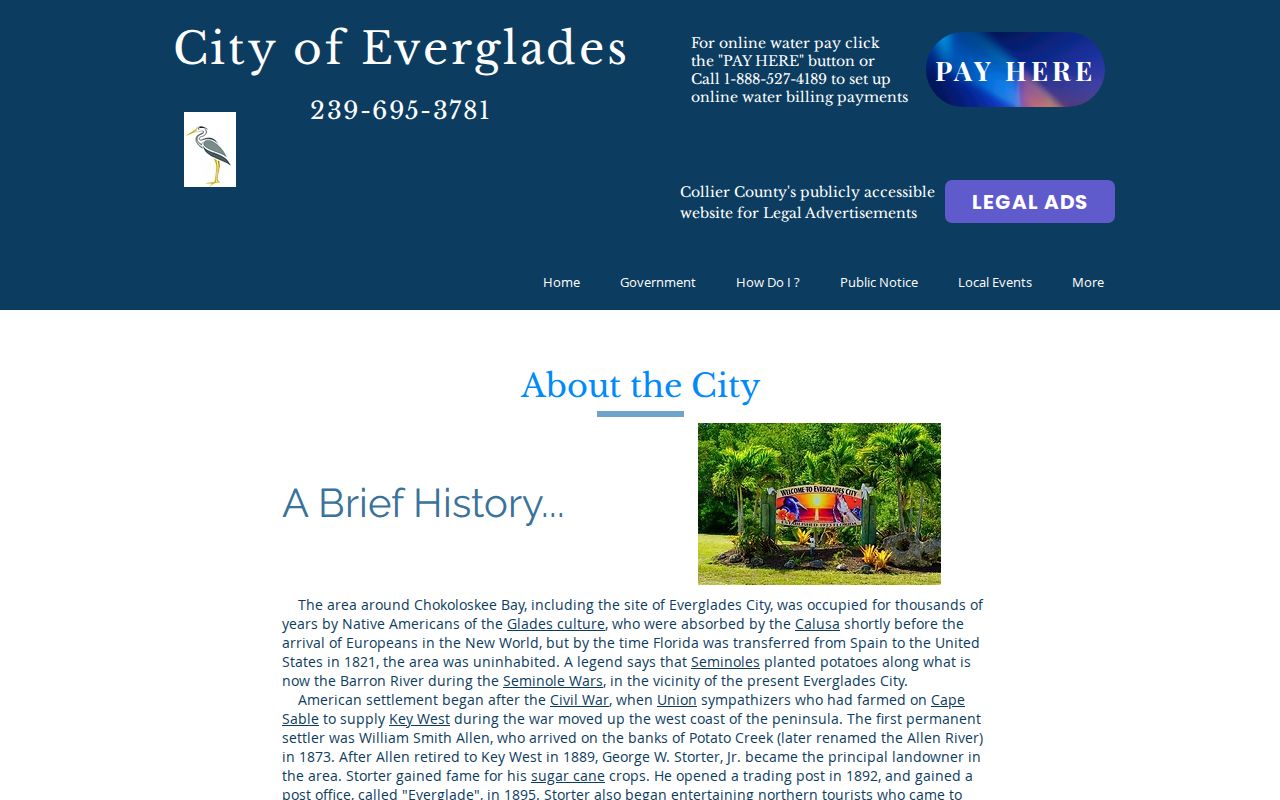
The image and source connect the former county-seat role to the present records route.
Storm Closures and Record Trips
Storms can alter access to the small City Hall office and county routes. Resolution 2024-22 declared an emergency on October 7, 2024, for Hurricane Milton and adopted the county evacuation notice. That event does not change which office owns a file, but it shows why a phone call before travel matters during or after severe weather.
Use the published city and county phone channels to confirm hours. An online or mail request may be safer when offices are closed, yet response time can still reflect emergency operations.
Everglades City Report Details
A broad request can reach the wrong small office or require avoidable research. For a city record, name the meeting, resolution, ordinance, code matter, date range, and preferred format. For a law-enforcement record, give CCSO the incident number when known. Otherwise list the location inside Everglades City, event date, approximate time, involved parties, and the exact file needed.
Modern incidents can create more than a narrative. A complete request may separately identify the incident report, arrest affidavit, CAD log, 911 audio, body-camera video, photographs, or evidence records. Each can have its own retention and exemption questions. Florida law makes some body-camera recordings from residences, health or social-service facilities, and other private places confidential, subject to statutory access and court provisions.
Submitting promptly helps when a time-sensitive recording is involved. CCSO research states that body-camera material covered by the cited provision must be retained for at least 90 days, but that minimum should not be treated as a promise of indefinite availability.
City Population and County Crime Data
The official April 1, 2025 estimate places Everglades City at 382 residents. County-wide crime totals cover a far larger area and should not be labeled as city-only counts. With no municipal police UCR report, a precise city-limits total may require a Chapter 119 request to CCSO that clearly defines the date range, offense measure, and geographic boundary.
The federal Collier County population context illustrates the scale of the broader county.
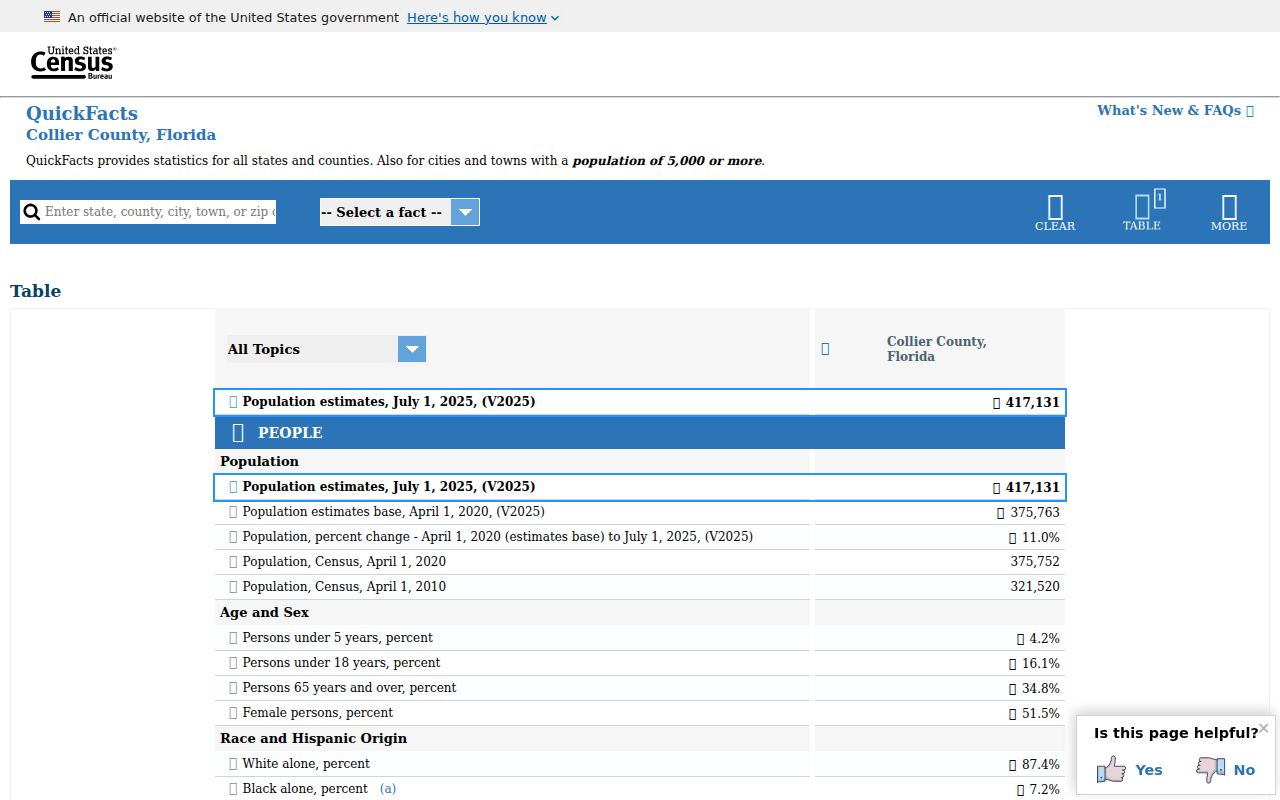
That difference in scale is why a county total cannot fairly stand in for Everglades City activity.
Where Everglades City Records Go
CCSO creates the incident and arrest records because the city has no police department. The sheriff also creates the jail booking. The State Attorney decides filed charges, and Collier Clerk holds the court case. FDLE later compiles qualifying fingerprint arrest events and reported dispositions.
Record flow: Collier County Sheriff's Office › CCSO jail › Collier County Courts › Florida Department of Law Enforcement.
The City Clerk is outside this criminal record flow unless a separate municipal document is requested. That is the central local distinction.
Everglades City Record Search Gaps
A blank online result does not settle whether a public file exists. A recent CCSO report may precede the court case. An older public court document may not be available through the online viewer. Sealed, expunged, juvenile, victim-protected, or active-investigation material may be restricted by law. Verify the agency, spelling, aliases, date range, and record type before concluding that no match exists.
When a known Collier outcome is missing from an FDLE history, the subject may use FDLE's free fingerprint-based Personal Review and challenge process. A certified disposition from Collier Clerk can document the final result. Differences between the police allegation, booking charge, filed information, and disposition are not always errors. Each describes a different stage in the same event.
For an Everglades City inquiry, also confirm that the search has not stopped at City Hall. Municipal records staff do not maintain the CCSO or clerk databases.
Public Access Rules in Everglades City
Chapter 119 applies to city and sheriff agency records unless a specific exemption applies. Rule 2.420 governs court records. Protected victim data, juvenile information, active intelligence, and personal identifiers may be withheld or redacted, while public portions remain available.
Key Statutes:
Florida Statute §119.01 states the public-access policy for municipal and county records.
Florida Statute §119.07 covers inspection, copies, redaction, and denial grounds.
Florida Rule 2.420 identifies public and confidential judicial material.
Ask the custodian to cite the precise basis for a denial. Public access does not turn an allegation into proof of guilt.