
Collier County Arrest History
The Collier County Sheriff's Office arrests people in unincorporated areas and maintains every county jail booking. Naples Police and Marco Island Police create arrest and incident reports inside their city jurisdictions. Florida Highway Patrol and the Florida Fish and Wildlife Conservation Commission may also make arrests within Collier County. The arresting agency keeps its own report, even when CCSO accepts the person at a county jail.
An arrest history is a series of arrest and booking events. It is not a list of convictions. CCSO's official search offers current daily reports and prior name or date searches. Its current mobile description advertises ten years of Collier arrest history, while an older launch notice referenced records back to 2000. Treat the live interface as the authority for present retention instead of promising a fixed start date.
CCSO Collier Arrest Search
The CCSO arrest search is free and does not require an account. A visitor must read the notice and choose “I ACCEPT” before entering. Searches may use first name, last name, arrest or booking date, or booking number. A separate link opens today's arrest reports. A booking number gives the narrowest route when it is known.
CCSO calls the interface a courtesy rather than a substitute for a public-records request. It warns that arrest information reflects facts known at the time and has no connection to guilt, innocence, dismissal, or acquittal. Verify any match with the source office and use the Collier Clerk for the final judicial result.
The official ten-year arrest-history interface shows the CCSO terms and search entry used for Collier County arrest records.
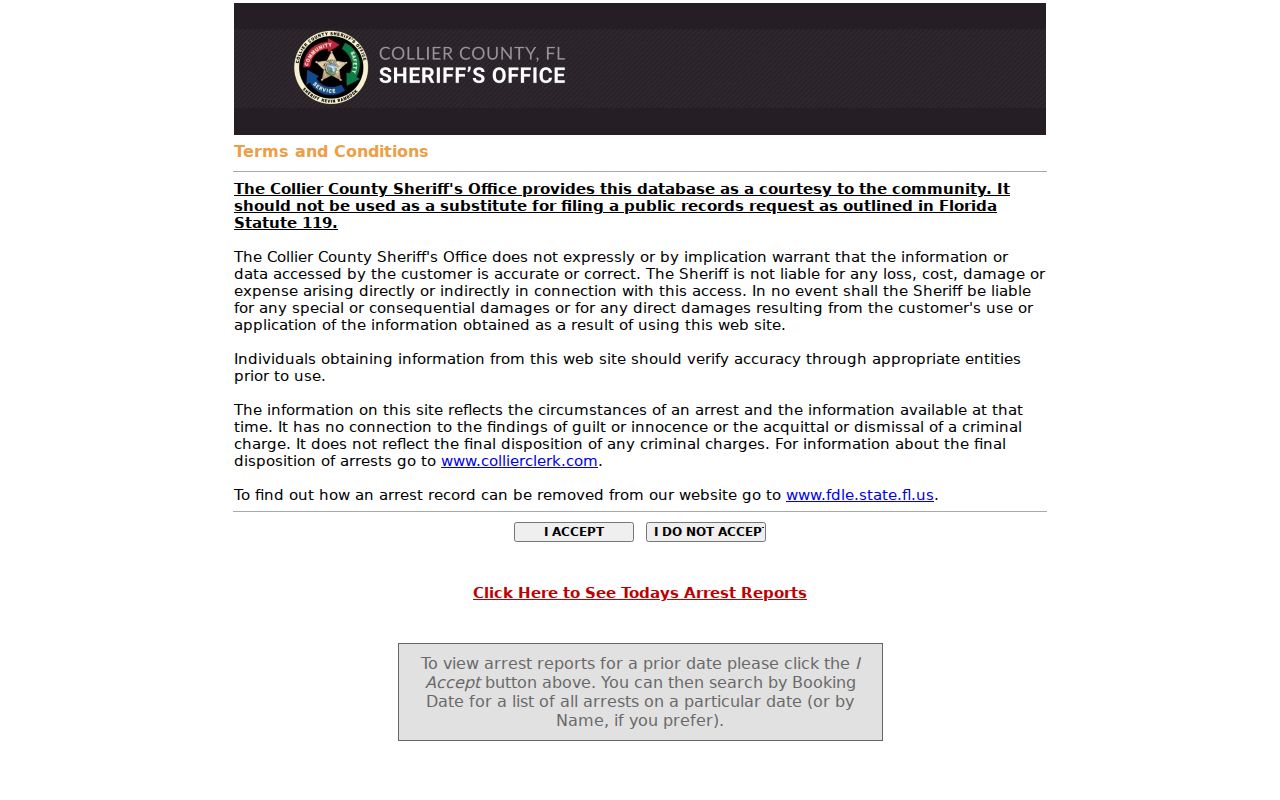
The image represents the official search channel, not a gallery, and each listed allegation still requires court confirmation.
Looking Up Collier County Arrests
Use each official channel for the fact it controls. A daily report answers whether a booking was recently posted. Jail staff can confirm present housing, bond, or release information. The clerk's case system shows whether prosecutors filed charges and how the case ended.
- Open the CCSO arrest search, accept its terms, and search today's report or use a name, date, or booking number for prior entries.
- Call the Naples or Immokalee jail when current custody, housing, bond, court date, or release status must be verified.
- Request the incident or arrest report from CCSO Central Records, Naples Police, Marco Island Police, or the other arresting agency that created it.
- Search the Collier Clerk Showcase for the filed criminal case, then compare the booking charge with the filed counts and disposition.
- Use FDLE's Florida Criminal History Search for a statewide public history or fingerprint Personal Review for your own record.
- When an online entry is missing or wrong, make a focused Chapter 119 request with the date, location, report number, or booking number.
This sequence also handles a transfer. FDC Offender Search may show a person who has moved into state custody or supervision after leaving the county jail.
Collier Arrest Check by Request
CCSO Central Records provides a Local Criminal Background (Arrest) Check for Collier County adult arrests. The subject must be at least 18. A request needs the first and last name plus date of birth, costs $10, and generally takes three to five business days. This is a local arrest letter, not a statewide conviction check.
Requests may use the sheriff's online public-records portal or mail. A mailed request needs a $10 check or money order and a self-addressed stamped envelope. Do not mail cash. Incident reports also generally need three to five business days after the event to reach Central Records.
CCSO Central Records Bureau
3319 Tamiami Trail East
Naples, FL 34112
(239) 252-0637
Monday-Friday, 8 a.m.-5 p.m.
records@colliersheriff.org
Inside a Collier County Arrest Record
A CCSO arrest entry describes a booking event with information available then. It can help locate the related report and case, but it does not supply the final court disposition. Read the arresting agency, booking number, and dates before relying on a same-name result.
| Booking number | The CCSO identifier used to locate the intake event and ask jail staff about the booking. |
|---|---|
| Booking date | The date of jail intake, which may differ from later filing and hearing dates. |
| Arresting agency | CCSO, a city police department, or another agency that created the source arrest report. |
| Charges | Arrest-time allegations that may change when the State Attorney reviews the case. |
| Bond | Release amount or type shown at that stage; call the jail for current information. |
| Photograph | The official log and app may display a booking image; it is not proof of guilt. |
| Release status | A point-in-time custody fact that can change after bond, court action, or transfer. |
Final disposition belongs in the Collier Clerk case. A prior entry can remain part of the arrest record even when prosecutors file different charges, dismiss the case, or file nothing.
Two Collier County Jail Centers
CCSO operates the Naples Jail Center at 3347 Tamiami Trail East, Naples, FL 34112-4434, phone (239) 252-9504, and the Immokalee Jail Center at 302 Stockade Road, Immokalee, FL 34142, phone (239) 657-2878. Staff at either lobby can provide direct verification appropriate to that facility.
Housing is based on safety, needs, and security, not on which part of Collier County produced the arrest. A Naples arrest can lead to housing in Immokalee, and the reverse is also possible. People who qualify may leave custody through court-ordered Pretrial Supervision after first appearance. Published bond routes include full cash, full cashier's check, or a surety bond through a bonding company. Call the jail for current court, release, and bond facts.
Booking Logs and Recent Arrests
Today's Arrest Reports is the quickest official view of newly posted Collier County bookings. For an older event, use the name, date, or booking-number fields after accepting the CCSO disclaimer. The result may include a name, photograph, booking number, arrest date, arrest charges, and prior Collier arrest history. It does not establish the final charge or outcome.
The CCSO2go mobile app advertises name and date arrest search, charge details, photographs, and ten years of Collier arrest history. It also offers traffic information, maps, videos, alerts, and a tip function. CCSO's reviewed descriptions do not advertise a warrant search, so the arrest feature should not be relabeled as one.
A person can leave the current jail view after release or transfer while the old arrest, agency report, and court case still exist. An absent current entry therefore proves little about prior Collier County arrest history.
Which Collier Arrest Agency Holds It?
Send the report request to the agency that made the arrest. CCSO Central Records handles unincorporated incidents and CCSO arrests. Naples Police Records Services is at 355 Riverside Circle, Naples, FL 34102, phone (239) 213-4890, email PolicePRR@naplesgov.com. Marco Island Police is at 51 Bald Eagle Drive, Marco Island, FL 34145, nonemergency (239) 389-5050, email publicrecords@cityofmarcoisland.com.
A Naples postal address does not always lie inside Naples city limits. Confirm jurisdiction before sending the request. Florida Highway Patrol keeps its own enforcement and crash records, while FWC retains its boating or wildlife enforcement reports. CCSO may still hold the jail booking for those arrests. Everglades City has no listed city police department, so CCSO is the local law-enforcement route there.
How Collier Arrest Records Spread
One arrest can create at least four files. First, the arresting agency writes the incident and arrest paperwork. Next, the Naples or Immokalee jail creates the booking number, intake file, photograph, and identity and fingerprint capture. Those fingerprints enter FDLE's criminal-history reporting chain. First appearance and bond create judicial entries, followed by a clerk case if the State Attorney files charges.
The flow is: agency report → CCSO booking → FDLE arrest cycle → Collier court case and disposition. Timing differs at each step. Immediate jail charges can differ from the information later filed in court. A delayed or mismatched disposition can also leave the statewide record incomplete. For your own Florida history, FDLE Personal Review supplies the fingerprint-based path to inspect and challenge an entry.
Chapter 119 Arrest Record Fallback
When the CCSO portal omits an event or contains a suspected error, request the source record under Florida Public Records Law. Describe the incident date, location, agency, report number, booking number, and record type as precisely as possible. Chapter 119 does not require every request to be written, but clear details help the custodian make a meaningful search.
Florida Statutes section 119.07 permits charges up to $0.15 for a one-sided page, plus $0.05 for a two-sided copy, actual duplication cost for other formats, and a special-service charge for extensive staff or technology use. Those baselines do not mean each electronic sheriff report carries that price. Juvenile material, victim information, active investigative records, and protected identifiers may be withheld or redacted. Ask for the statutory basis if access is denied.
Arrests Are Not Convictions
An arrest documents that an agency took a person into custody based on facts known then. A conviction follows a plea or finding of guilt in court. Between those points, prosecutors may decline a case, amend charges, or dismiss counts. The clerk's docket, not the booking log, provides the filed charges and final result.
| Arrest record | Conviction record |
|---|---|
| Created by the arresting agency and jail | Created through the court case |
| Shows an arrest and booking occurred | Shows a legal finding or plea of guilt |
| Held by the agency and CCSO booking system | Held by the Collier Clerk and reported to FDLE |
| May lead to no filed charge or a dismissal | Leads to sentence and may later qualify for relief |
Note: A Collier County arrest is not proof of guilt, and many arrest-time allegations change before a case reaches final disposition.