
Checking Collier County Criminal History
No single Collier County criminal-record search is complete on its own. Start with the Collier Clerk Showcase for filed criminal cases. The public system does not require registration, and most nonconfidential docket details and documents may be viewed without a fee. It can show the case number, filing date, charge counts, status, court dates, costs, and docket events. Remote access follows the Florida Courts security matrix, so a missing PDF may still be available at a courthouse terminal or through a records request.
Use the sheriff for a Collier-only arrest check or recent custody, the Florida Department of Law Enforcement for a statewide public history, and fingerprints for a free personal review of your own FDLE record. The four sources answer different questions. Match a common name with a birth date or other lawful identifier before treating a result as the right person.
- Search the clerk by legal name, case number, or citation and narrow broad results by date or case type.
- Check CCSO arrest and inmate channels when the issue is a local booking or current custody.
- Use FDLE for a public Florida repository search, not as a substitute for the court docket.
- Compare filed charges and dispositions with the arrest entry because the descriptions can change.
- Order a certified court copy or use fingerprint personal review when the purpose calls for an official or identity-linked record.
Four Collier Criminal Record Systems
Collier records divide by event and custodian. A law-enforcement agency writes an incident or arrest report. The jail makes a booking file. The State Attorney decides whether to file a charge, and the Clerk of the Circuit Court opens the judicial case. Arrest fingerprints and later dispositions may then reach FDLE. State prison and adult felony supervision records sit with the Florida Department of Corrections.
| Official source | Best starting point | Main limit |
|---|---|---|
| Collier Clerk | Filed charges, docket, outcome, sentence | Collier cases only; protected items withheld |
| CCSO | Local arrest check, booking, jail custody | An arrest is not a finding of guilt |
| FDLE | Public statewide criminal history | Name results are not fingerprint-confirmed |
| FDC | State prison or community supervision | Does not cover current county jail bookings |
The record flow is often: incident or arrest → booking and fingerprints → charging decision → court docket and disposition → repository update. A delay or identifier mismatch can leave an outcome unlinked. That is why a reliable Collier County criminal history review checks the source file rather than relying on one summary.
Florida Official Background Checks
The Florida Department of Law Enforcement offers several distinct products. Instant Search costs $24 plus a $1 card-processing fee, returns a printable or emailable result at once, and is not certified. A staff-processed certified or non-certified search costs $24. FDLE states five business days for non-certified work and six to seven business days for certified work, not counting mail delivery.
A subject who wants to inspect or challenge their own Florida criminal record may use FDLE's free fingerprint-based Personal Review under section 943.056. Fingerprints must be taken by a law-enforcement or criminal-justice agency and sent with the application. ORI-based LiveScan is different. The requesting agency supplies the purpose code and ORI, an approved provider captures the prints, and the result goes to the agency tied to that ORI.
The FDLE check-options source shows why a public name search and an authorized fingerprint check should not be treated as the same service.
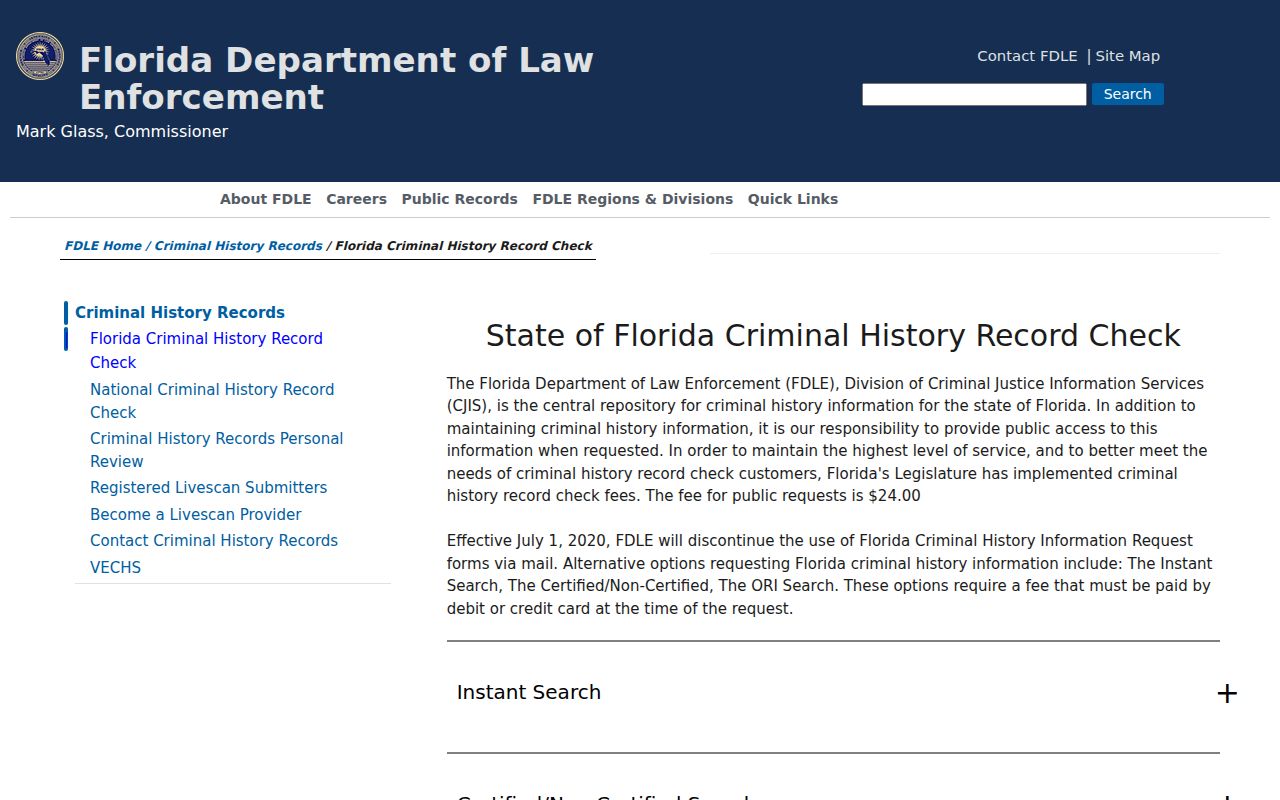
Its separate paths help Collier County searchers choose between an immediate public result, certified processing, and a purpose-coded official channel.
FDLE Collier History Search Fields
The Florida Criminal History Search relies on demographic data. Spelling matters, and a common name can yield uncertain matches. Use a middle name and date of birth when known. Only enter sensitive data on the official secure FDLE domain.
| Field | Use | Practical point |
|---|---|---|
| Last and first name | Required identity search | Use the legal spelling |
| Middle name | Optional narrowing | Helps separate similar names |
| Date of birth | Identity discriminator | Enter the displayed format |
| Race and sex | Demographic matching | Use only accurate known facts |
| Payment | Completes Instant Search | $24 plus $1 card fee |
The official FDLE search screen illustrates the statewide name-based route used for a Collier County criminal history request.
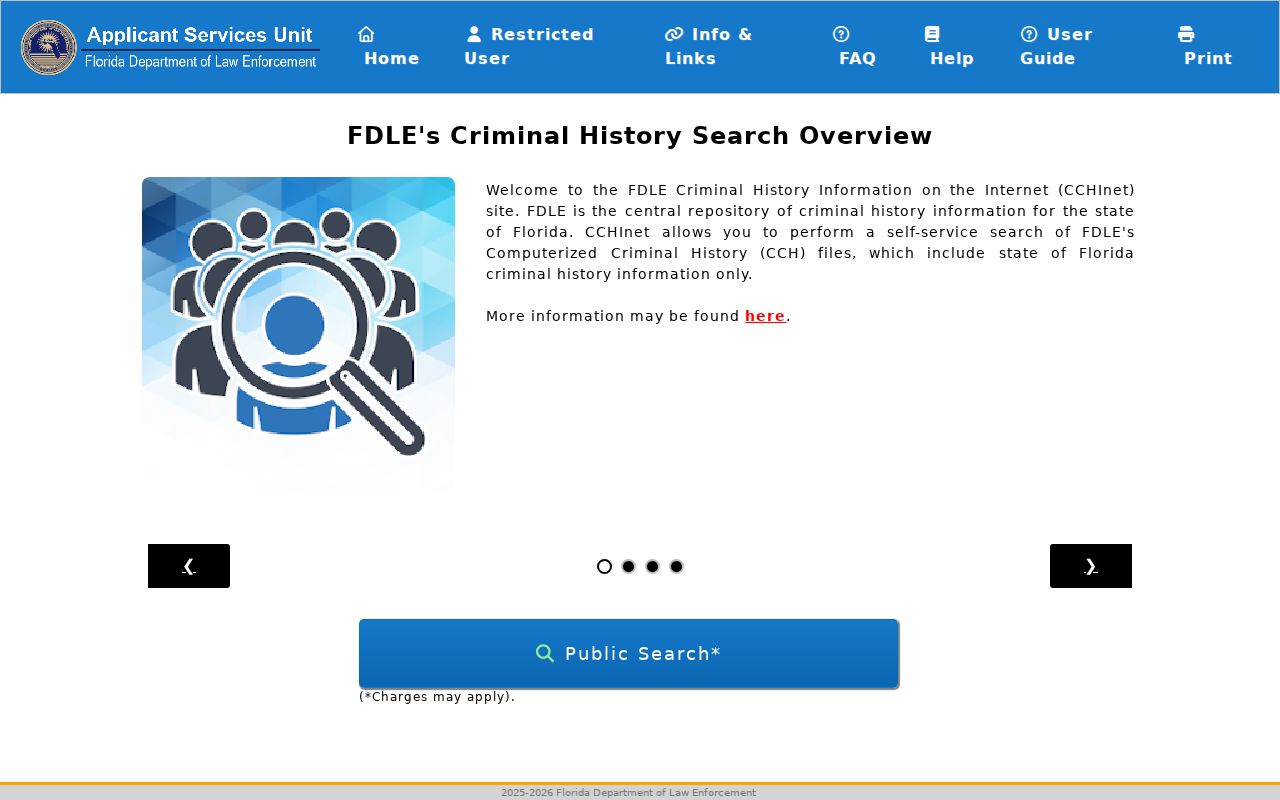
A no-record response does not rule out a county incident, a non-fingerprinted event, an out-of-state matter, or a lawfully restricted record.
Collier County Criminal Record Types
Each record marks a different stage. Naples Police, Marco Island Police, CCSO, campus police, or another arresting agency may retain the initial report. CCSO creates booking and custody entries when a person enters a county jail. The State Attorney's filed charge can differ from the arrest allegation, while the clerk's docket tracks hearings, pleas, rulings, disposition, sentence, and costs.
- Incident and arrest reports: officer accounts and agency action, subject to redaction and investigative exemptions.
- Booking records: intake identifiers, arresting agency, alleged charges, bond, and custody state.
- Court files: filed charges, docket events, judgments, sentences, and financial entries.
- Warrants: judicial process maintained through court and law-enforcement systems.
- Custody and supervision: CCSO jail data, FDC prison or community supervision, and court-ordered terms.
- Registry records: FDLE sexual-offender and predator information, which is not a full criminal history.
Federal cases are another layer. The Middle District of Florida serves Collier County, and PACER holds the federal docket. County and FDLE tools do not replace that search.
Collier Criminal Records Campus
The Collier County Courthouse and Government Complex is the main in-person hub at 3315 Tamiami Trail East in Naples. The clerk's Courts Department is in Suite 102 and can be reached at (239) 252-2646. Court Administration lists weekday hours from 8 a.m. to 5 p.m. Public terminals can expose lawful case information that the remote security matrix does not display, and staff can route requests for plain or certified copies.
CCSO Central Records is close by at 3319 Tamiami Trail East, Naples, FL 34112. Its counter is open Monday through Friday from 8 a.m. to 5 p.m.; the phone is (239) 252-0637 and the records custodian email is records@colliersheriff.org. Requests may go through the online portal or by mail. A mailed local arrest-check request needs the required payment and a self-addressed stamped envelope. Do not mail cash.
Collier Clerk Courts
3315 Tamiami Trail East, Suite 102
Naples, FL 34112
(239) 252-2646
CCSO Central Records
3319 Tamiami Trail East
Naples, FL 34112
(239) 252-0637
The Twentieth Judicial Circuit courthouse page provides the official location context for Collier County criminal court records.
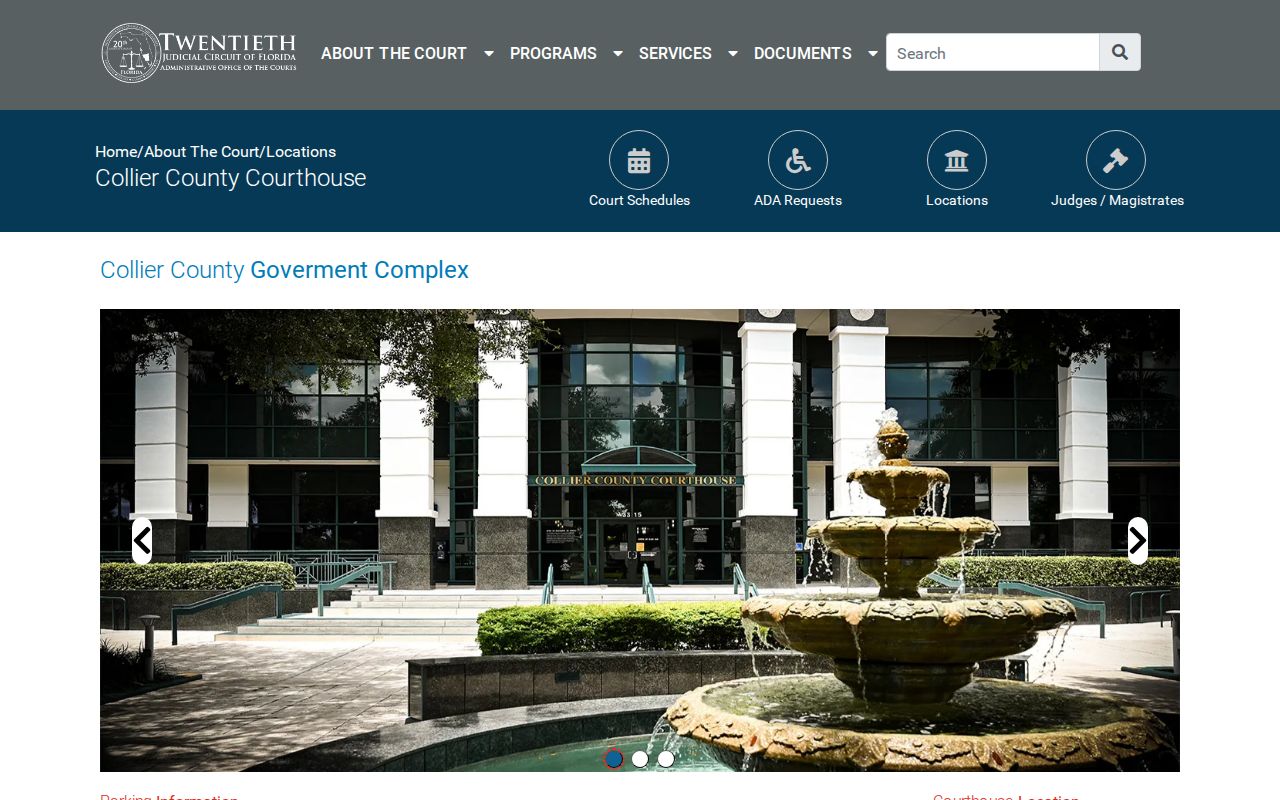
Free garage parking is south of the courthouse, but visitors should allow time for security screening and leave prohibited items, including drinks and metal tools, behind.
Inside a Collier County Criminal Record
A complete-looking result may still be only one part of the history. Read the source label first. An FDLE compilation links arrest cycles and reported outcomes. A Collier clerk file documents one prosecution. A booking entry records intake and allegations at that time.
| Name and identifiers | Names, aliases, birth data, and agency or state identifiers used to distinguish records. |
|---|---|
| Arrest data | Date, arresting agency, event number, booking information, and arrest charges. |
| Filed charges | Case number, counts, Florida statutes, degree, and charging instrument. |
| Disposition | Dismissal, nolle prosequi, acquittal, plea, adjudication, or other result for each count. |
| Sentence | Confinement, probation, community control, costs, fines, or restitution when recorded. |
| Custody status | County jail, FDC custody, release, or state supervision, depending on the source. |
Disposition means the operative outcome. A nolle prosequi means the prosecutor stopped a filed charge. A withhold is not a dismissal; it means the court withheld formal adjudication despite a plea or finding.
Collier Warrant Record Fallbacks
Collier County has no verified, full public warrant portal in the research. Start with Clerk Showcase for a case number, capias, failure-to-appear event, or bench-warrant docket entry. If remote detail is withheld, contact the clerk or inspect the case at a courthouse terminal. The court record is the best source for why judicial process issued.
For law-enforcement confirmation, submit a focused public-record request to CCSO Central Records or call the sheriff's nonemergency channel. An agency may withhold sealed, juvenile, active-investigation, or operationally sensitive material. A person who believes a warrant may concern them should seek direct confirmation and legal advice instead of relying on a same-name web result or attempting to confront anyone.
Note: Absence from a public search does not prove that no active Collier County warrant exists.
Public Access Laws in Florida
Florida Public Records Law covers state, county, and municipal agency records unless an exemption applies. Judicial files follow Florida Rule of General Practice and Judicial Administration 2.420. Custodians should provide nonexempt portions after redaction and cite the legal basis when access is denied.
Key laws:
Florida Statutes §119.01 states the public-access policy for agency records.
Florida Statutes §119.07 governs inspection, copies, redaction, and stated grounds for denial.
Florida Statutes §943.053 controls FDLE criminal-history dissemination.
Florida Rule 2.420 protects access to nonconfidential court records while defining confidential material.
Common limits include juvenile files, victim information, Social Security and account numbers, active criminal intelligence, protected addresses, and sealed or expunged records. Public availability does not establish guilt and does not authorize misuse.
Collier Jail or Florida Corrections
A Collier jail search and an FDC search cover different populations. CCSO operates the Naples Jail Center and Immokalee Jail Center. A person's arrest location does not determine which center will house them, and a later transfer or release can remove them from a current-custody result without erasing the booking or court case.
The FDC Offender Search covers state prison and state community supervision. It is the right statewide channel for an FDC inmate, probationer, or other supervised person, not for someone held only in the Collier County jail.
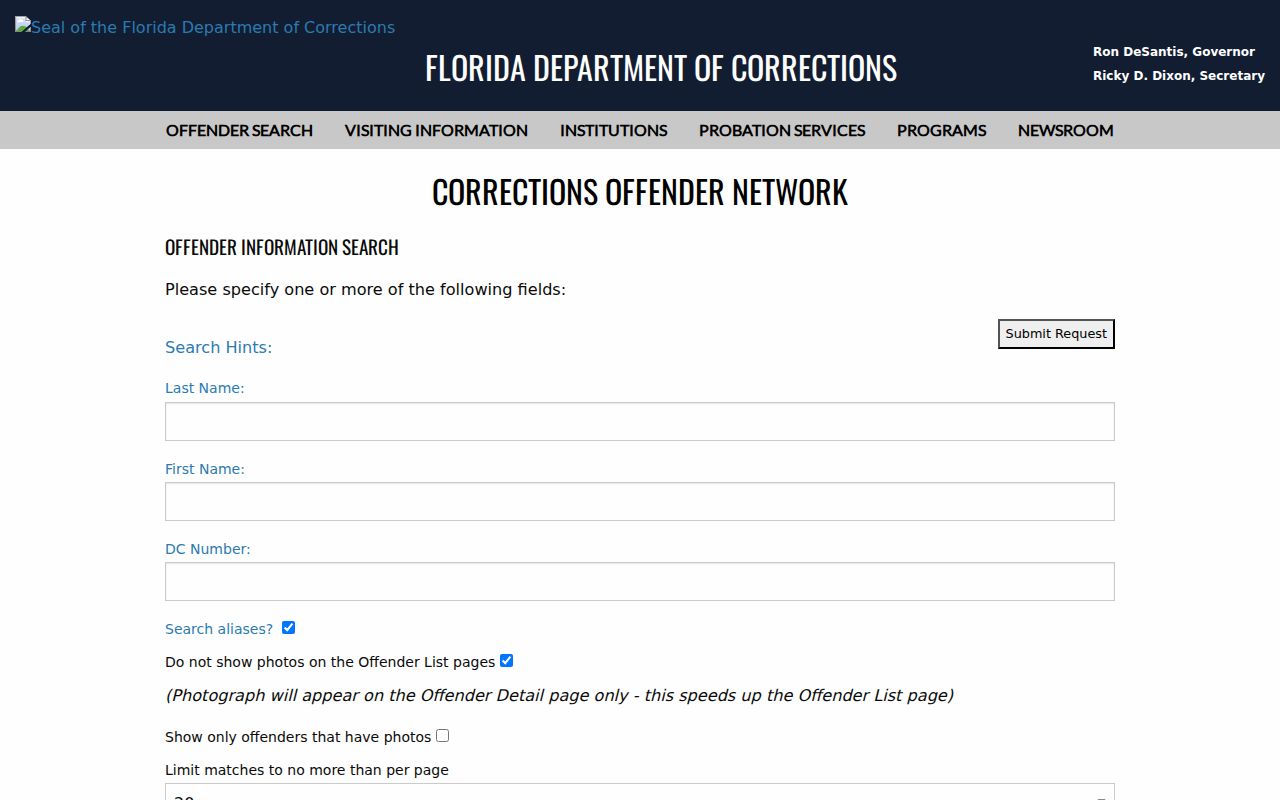
The official locator makes the custody boundary clear and helps prevent a false conclusion when the county jail roster returns no current match.
Sealed, Expunged, and Restricted Records
Florida sealing and expunction restrict public access, but they are not the same remedy. Under section 943.059, a sealed agency record remains confidentially retained and specified agencies keep statutory access. Under section 943.0585, expunction generally requires destruction or expungement as ordered, with an FDLE control notation and narrower access. Both ordinary routes require an FDLE Certificate of Eligibility before a petition is filed in the proper Collier court.
A dropped Collier County charge does not always vanish from every public system. Automatic sealing under section 943.0595 can cover qualifying no-file, dismissal, or nolle prosequi events, subject to exclusions. Other records may require a court order. Common disqualifiers include a prior adult guilty adjudication, an incomplete sentence, a listed offense, or prior Florida relief.
The FDLE seal and expunge hub is the official starting point for checking eligibility and forms.
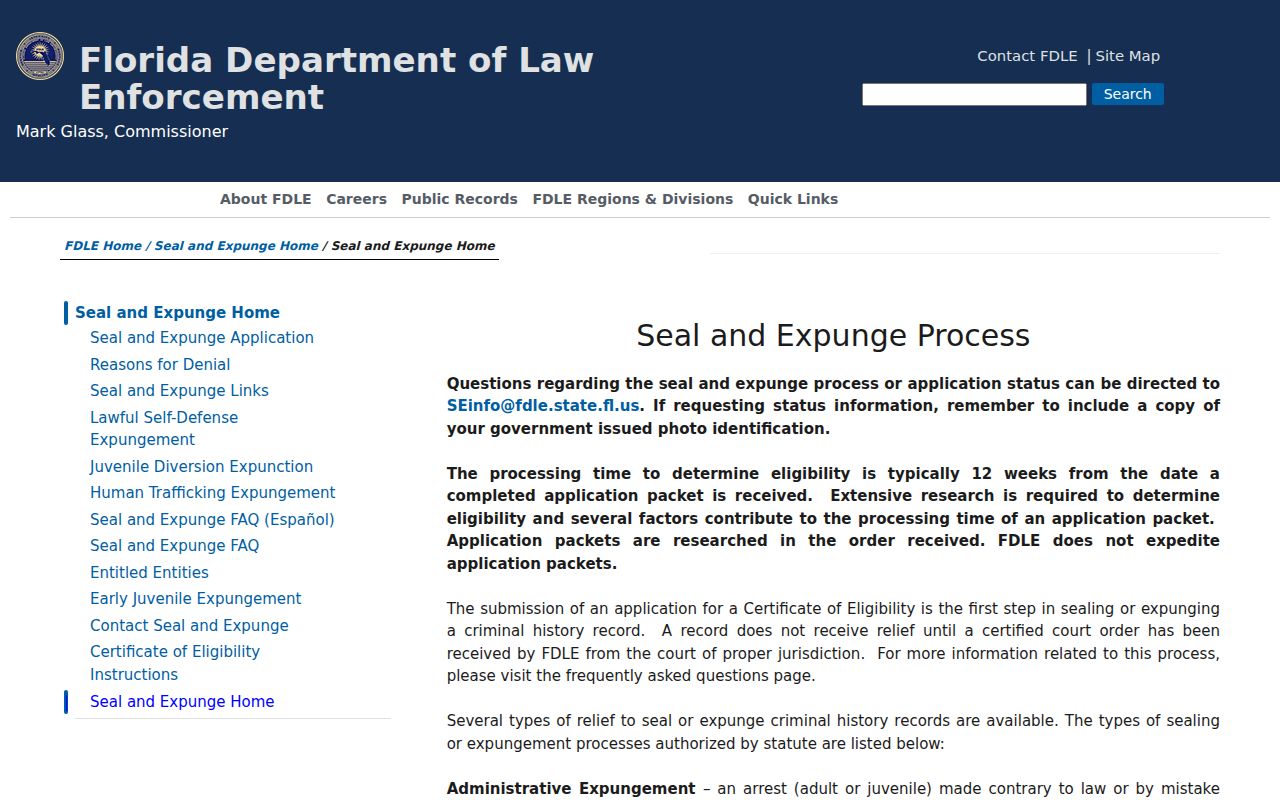
After obtaining a certified disposition from the Collier Clerk, the applicant sends the FDLE packet, fingerprints, required papers, and $75 nonrefundable fee, then petitions the court after a certificate issues.
Correcting Collier Criminal History
When an FDLE entry is incomplete or appears tied to the wrong identity, use Personal Review rather than buying repeated name searches. The requester or designated attorney submits the application and fingerprints to FDLE's Criminal History Record Maintenance Section. The review is free, though a local agency may charge to take prints. FDLE provides a challenge route for a missing disposition or inaccurate identifier.
For suspected identity misuse, FDLE Compromised Identity Services uses a claim form and fingerprints. If analysis confirms that a claimant's identifiers appear in another person's arrest record, FDLE coordinates with the source law-enforcement agency to correct the computerized file. A Collier court-file error should instead be raised with the clerk or originating office because FDLE does not rewrite the source docket.
The FBI electronic Identity History Summary service provides the separate subject-only national route.
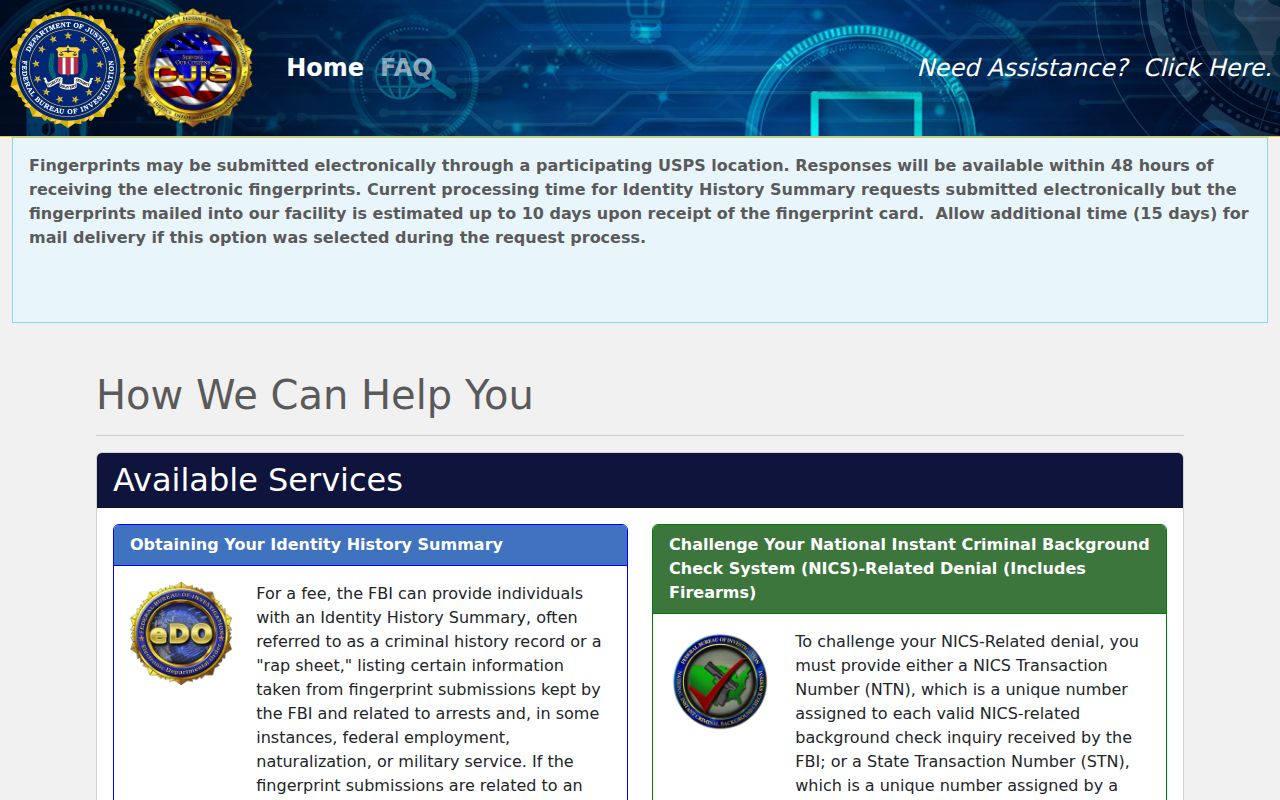
The FBI product is not a Collier court search, and disputed source information may still need correction by the agency that submitted it.
Collier Federal and Supervision Records
Collier County is within the Fort Myers Division of the U.S. District Court for the Middle District of Florida. Federal charges, filings, and judgments appear in PACER, while federal custody is searched through the Bureau of Prisons locator. Neither Clerk Showcase nor FDLE serves as the federal docket.
The Middle District of Florida source identifies the federal court layer that covers Collier County criminal cases.
Separating federal records from county and state systems keeps a no-result in one portal from being mistaken for a complete history.
Adult felony probation in Florida is state-run through FDC community corrections. Court records remain the source for the judgment and terms imposed, while FDC holds operational supervision information. Florida largely abolished parole for offenses committed on or after October 1, 1983, with statutory exceptions and older cases.
The Florida community corrections page explains the state supervision channel used for Collier County cases.
For misdemeanor probation, consult the sentencing docket because administration may rest with a locally designated service rather than the state felony system.
Collier County Criminal Records by City
Collier County has three incorporated cities: Naples, Marco Island, and Everglades City. Naples and Marco Island police retain their own incident and arrest reports, while bookings and prosecutions route to CCSO and the Collier Clerk. Everglades City has no listed city police department, so police, arrest, and jail questions go to CCSO. None of the three has a separate municipal criminal court.
Naples Criminal Records
Naples Police Records handles city police reports; Collier Clerk holds filed criminal cases.
Marco Island Criminal Records
Marco Island Police Records handles city material; county systems hold bookings and cases.
Everglades City Criminal Records
CCSO supplies the police and arrest channel; the Collier Clerk supplies court records.
City boundaries matter. A Naples mailing address can lie outside Naples city limits, which means CCSO rather than Naples Police may be the report custodian. Confirm the arresting agency before sending a request.